Everyday Holobionts
Everyday Holobionts is an ongoing durational practice with wind-fallen lichens, chamber lye, body chemistry and daily weather on Wadawurrung Country at Mount Egerton. The work maps co-terrain and co-temporality across paper and silk, holding the shared field where body, lichen, bacteria, season and place move through one another.
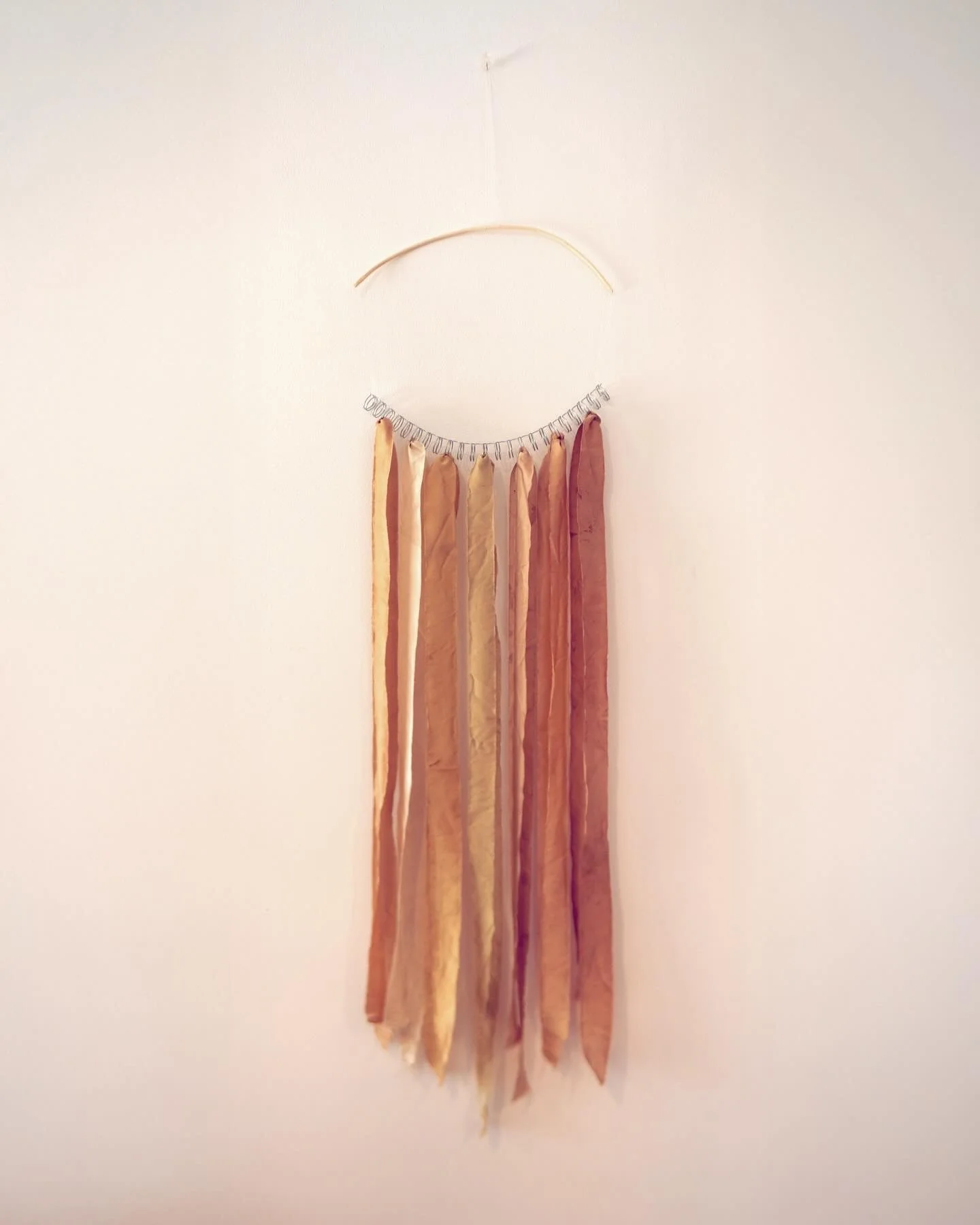
A Litmus of Time 2024–2025
Lichen dye on silk and paper, daily urine-based ferment, weather and body data
The first calendar work made after arriving at Mount Egerton.
The silk ribbons hold the earliest colour trials from spring 2024, dyed before a studio existed, using only what was available at hand.
The later paper calendars extend this method into daily grids and strata, mapping how body and place respond to time and weather together.
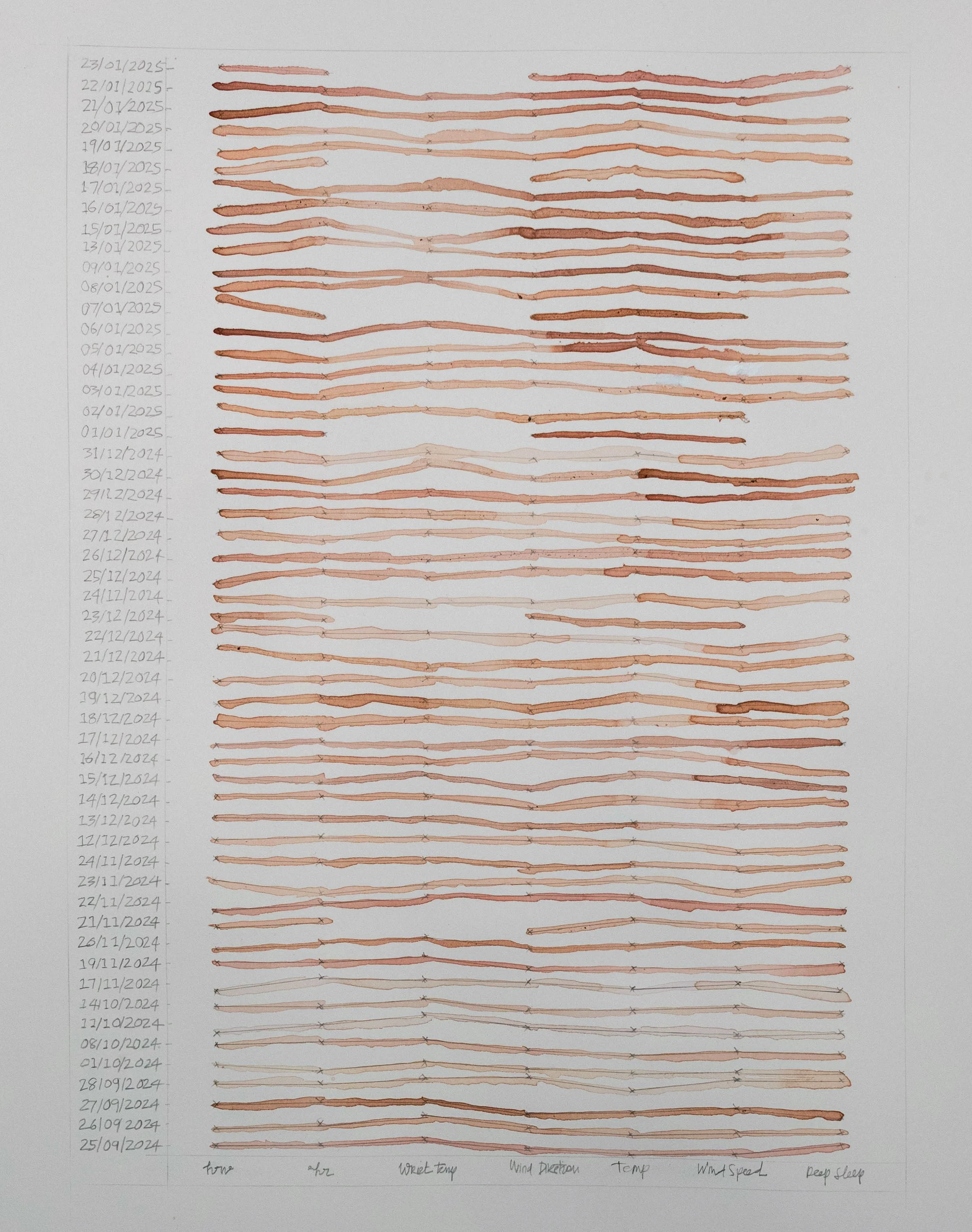
Strata 2025
Lichen dye on paper with layered temporal data
Built as a compression of time rather than a sequence.
Days accumulate as depth. Weather, fermentation and body rhythms imprint unevenly.
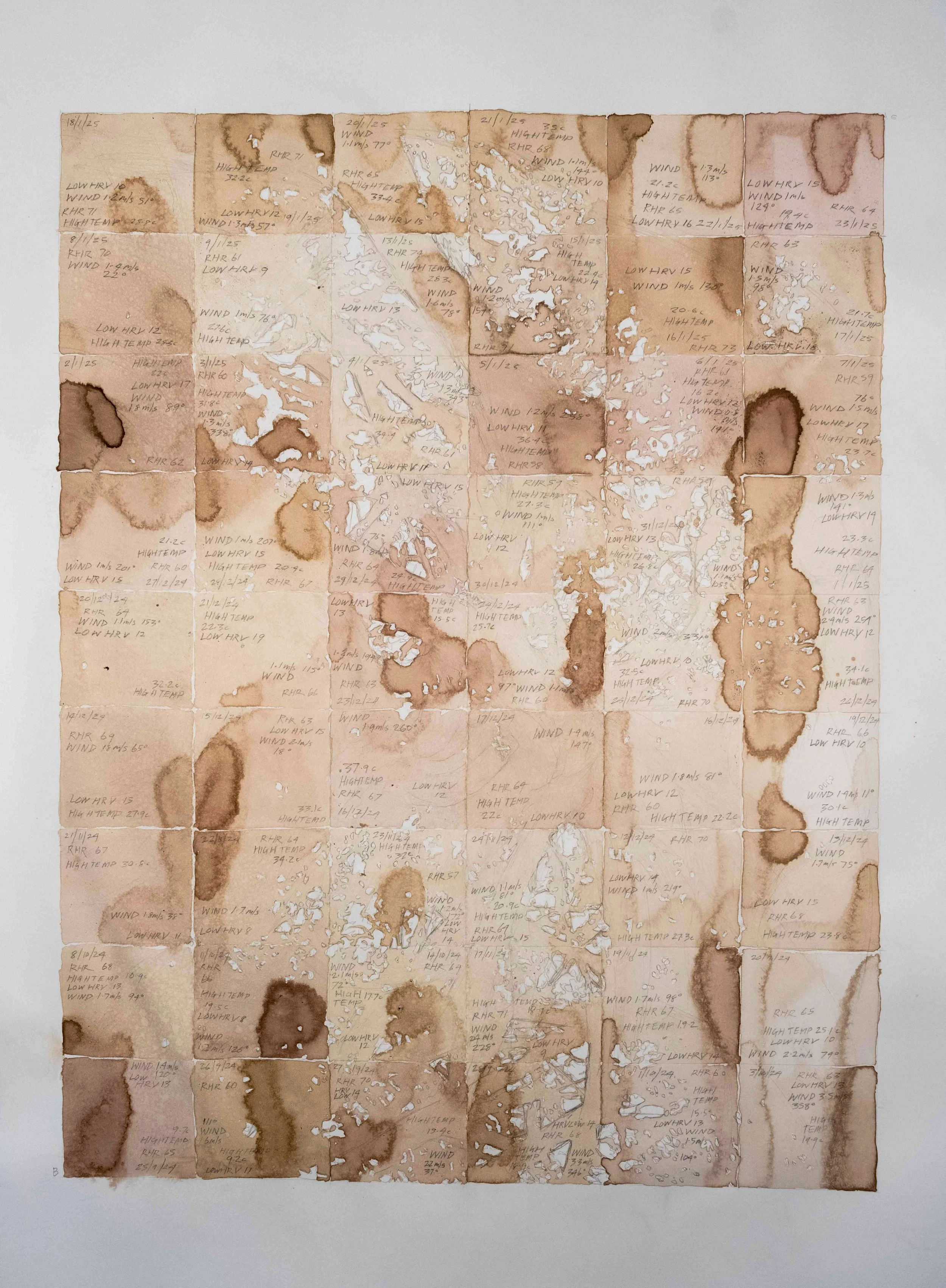
Everyday Holobionts: Co-Terrain, 2024-2025
Fifty-four days recording the language, weather and time between body and place. Each square holds a small calendar of environmental and body data, field notes written into traditional lichen ink washes outlining the Peppermint Gum they fell from.
Wind-fallen lichens gathered from my garden are fermented with chamber lye. The ink carries a commune of microbial life and patterns of place, fragments of the chemistry that has passed through and between us.
The work forms a wild terrain, a third space, where body, lichens and weather meet across different scales of time. Here, co-temporality becomes perceptible. Growth, fatigue, ferment, wind and seasonal drift do not move at the same speed, yet they touch. It offers a way of loosening the grip of collapse pace, and of remembering that many tempos coexist and quietly hold one another in place.
Field Notes: Everyday Holobionts
Mount Egerton, Wadawurrung Country 2024–ongoing
This body of work formed after I came to live on Wadawurrung Country at Mount Egerton. Here, lichens are not subject matter but neighbours, teachers and daily companions. They live across bark, stone, fence wire and fallen branches. They gather slowly where air, moisture, dust, fire history, wind and mineral drift meet. They register what passes through a place without choosing what to exclude.
After years of working with microbial and material intelligence, and with mistletoe as a guide into symbiotic life, lichens offered a way to practice this thinking as a daily, durational exchange. They are not singular organisms but small communities of fungus, algae and bacteria living together. They hold embedded histories of light, pollution, drought, rainfall and air movement. As bioindicators they carry a site inside their bodies.
I work only with wind-fallen specimens gathered from our garden and nearby ground. What I collect has already fallen and needs to be collected for firewood an fire protection. Because lichens grow slowly, often only a millimetre a year, this work is held as long commitment rather than harvest. Alongside gathering, I run a quiet experiment in return and regeneration, wetting remaining fragments and placing them back onto trees that already host the same species. I may not know for many years whether anything takes.
Lichens meet my body through chamber lye, a traditional alkaline dye base made from urine. Urine becomes a daily indicator of internal weather, mineral shift, fatigue, hydration, medication, heat and stress. When lichen and urine meet, a third field opens. Colour is not imposed. It emerges from exchange. Weather, season, body chemistry, microbial life and plant structure all participate.
This exchange unfolds across paper and fabric, through ink and dye, in sheets, lengths, calendars and strata. The distinction between drawing and dyeing is porous. What matters is how material behaviour records contact.
In the calendar works, each square holds a day of body and place data written into lichen colour fields. Wind speed, temperature, heart rate variability and resting pulse move alongside pigment behaviour. The grid does not stabilise time. It allows many tempos to remain visible at once. Some days bleed outward. Others resist. Some barely register. The work holds how bodies and places co-produce pattern without needing to agree.
Through this practice I began to name co-terrain. Not landscape as backdrop, but the shared conductive field where body, lichen, bacteria, weather, soil, mineral, memory and built structures move through one another. The studio, the garden, the body and the page all take part. No single element leads. Influence moves sideways.
From this, co-temporality becomes perceptible. Body rhythms, lichen growth, ferment cycles, weather shifts and geological inheritance do not run on the same clock. Sometimes they brush against one another. Sometimes they diverge. Sometimes one delays another. Time here is layered and uneven. It carries the pressure of multiple scales at once.
These works are not attempts at repair in any complete sense. They arise from living inside the long consequences of a broken culture. A culture that stripped bodies from land, labour from body, and time from both. Working this way is a form of learning-place. Not mastery. Not restoration to innocence. A slow re-entry into relation that does not promise resolution.
Everyday holobiont life is not heroic. It is breathing, digesting, sweating, fermenting, weathering, resting, failing, adapting. It is mutual dependence without guarantee. Lichens and body chemistry meet as equals in this sense. Neither controls the outcome. Both carry what has passed through them.
Across the broader works in this field, including the calendars, colour studies, terrain mappings, strata works and silk pieces, the practice remains the same. Attention held long enough for pattern to show itself. Materials allowed to behave. Time allowed to remain layered. The work becomes a way of staying with complexity without forcing it into clarity.
This is not a technique. It is a way of keeping company with this place and with the many lives that move through me and around me each day.
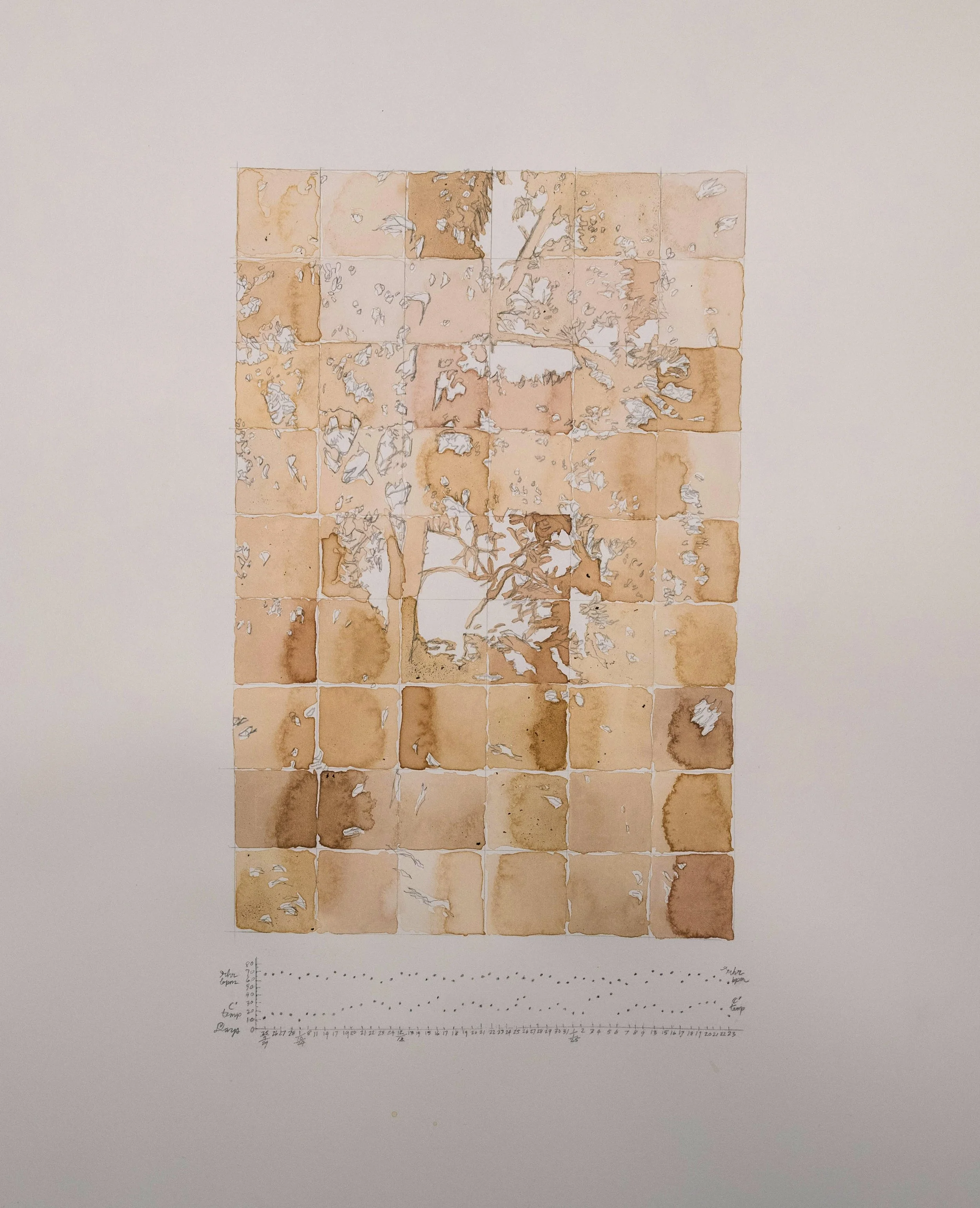
Waters’ Colour 2025
Lichen dye on paper with hydrological and atmospheric data
A study of how moisture, drift, evaporation and pigment movement register the behaviour of water across both body and site.