A Litmus of Time
Lichen works on time, hue, and the space between body and place.
A Litmus of Time gathers lichen works made on Wadawurrung Country at Mount Egerton from 2024 onward. Across paper and silk, wind-fallen lichens, chamber lye, bodily readings, daily weather, dye, drawing, calendars, strata, and sculptural forms are brought together. Hue becomes record, indicator, and one way of noticing what gathers between lichen, body, and site.
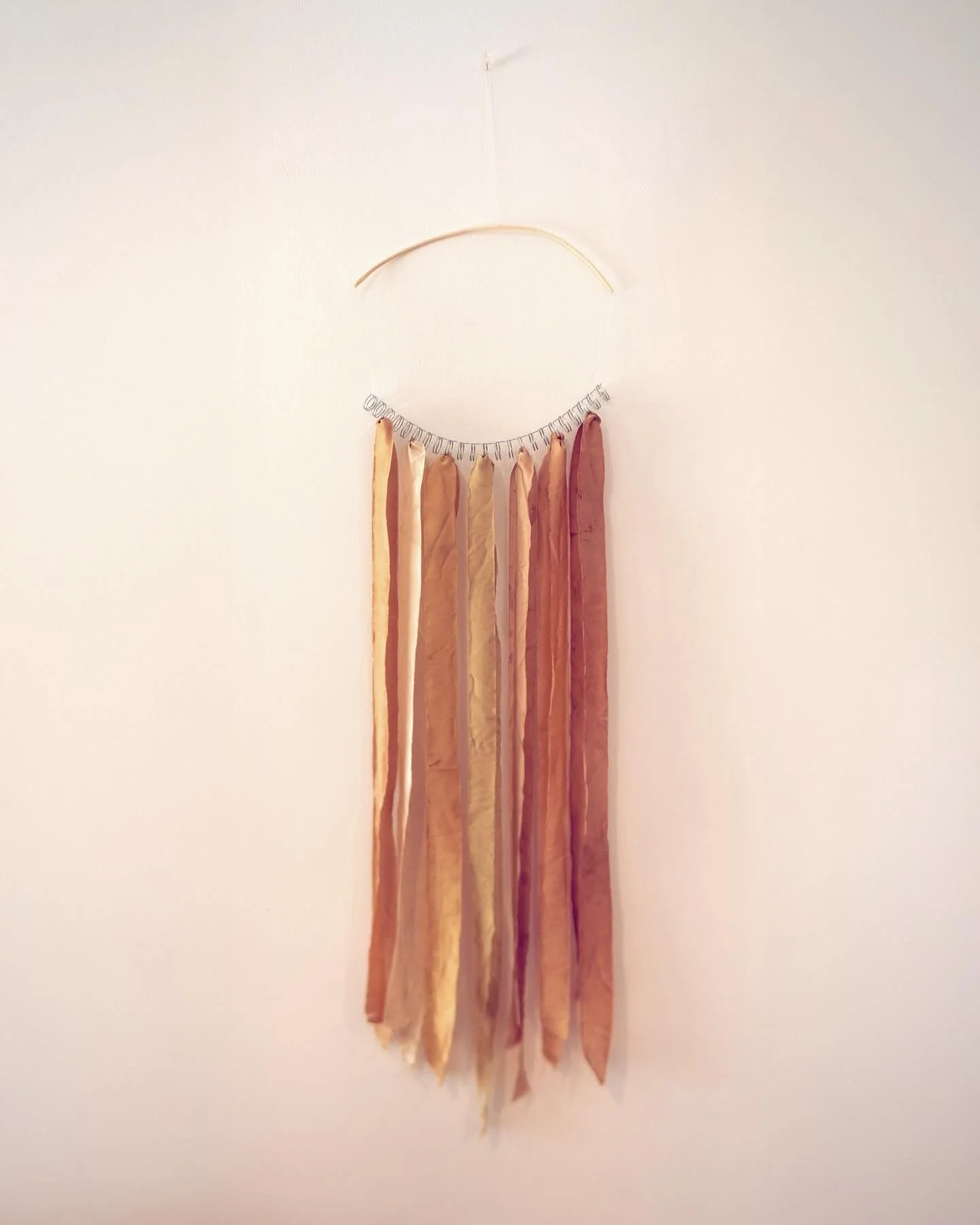
A Litmus of Time: Study 1 Bottled Spring 2024, completed 2025 The first calendar work made after arriving at Mount Egerton on Wadawurrung Country. This sculptural work was made before I had a studio, using remnant silk, windfall lichen, chamber lye, elm root suckers from the garden, and gathered water. The silk holds the earliest colour trials from spring 2024. Hot pipe and steam bent elm supports the dyed strips, which are suspended from a calendar binder and fishing line. The work began as a set of broad experiments, bottling different lichens and waiting for colour to declare itself, before the later paper calendars and strata works emerged. At that stage I was still trying to identify the lichens and often getting it wrong. The work shifted from naming toward colour, form, texture, and behaviour in chamber lye. In this way, A Litmus of Time: Study 1 became both an origin work and an early calendar of body, place, and material change.
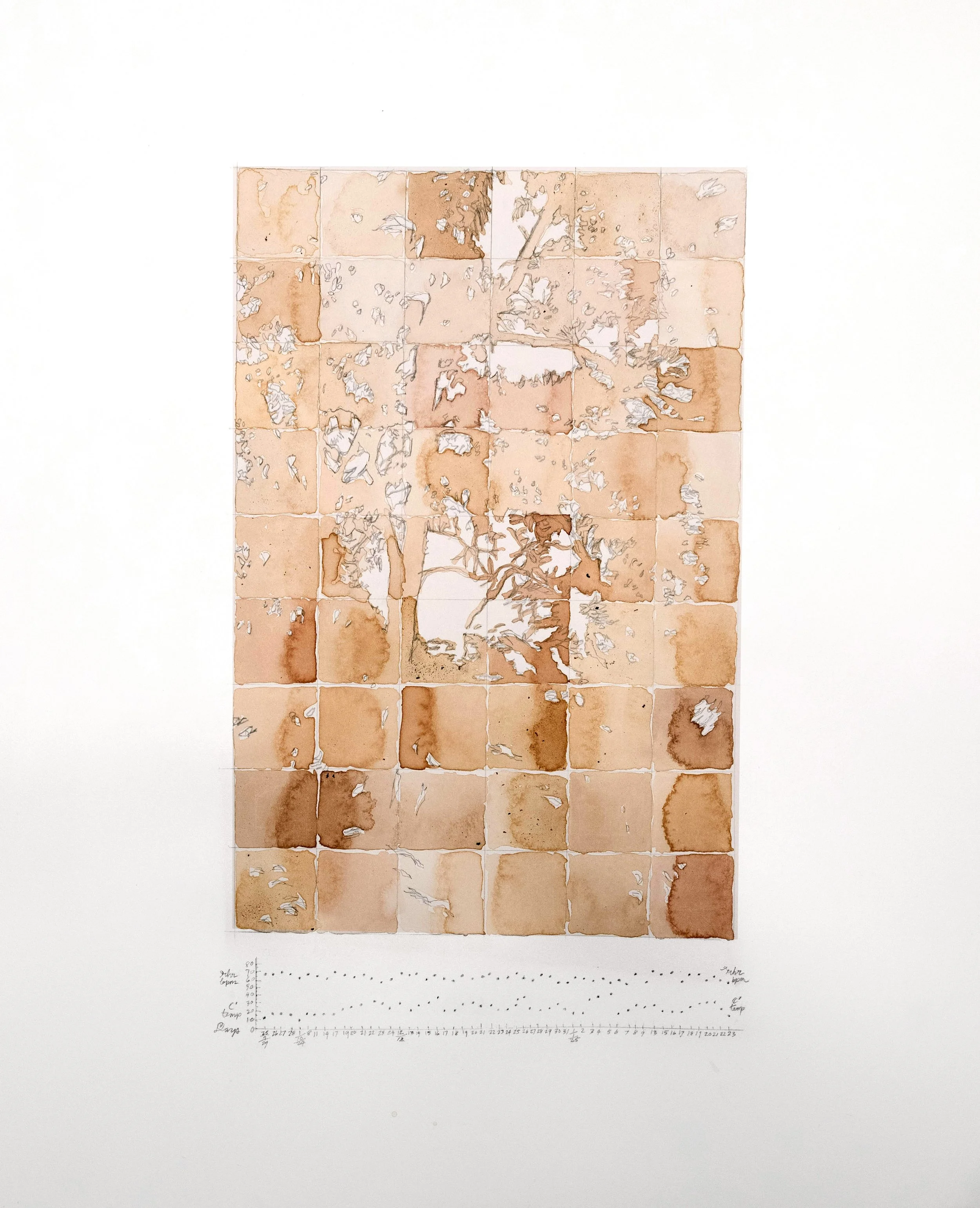
Everyday Holobionts: Waters’ Colour 2025 Fifty four days of environmental and physiological readings are rendered through lichen ink made from windfall species, chamber lye, and graphite on paper. Peppermint gum silhouettes, the host trees from which the lichens were dislodged, hold washes of colour, while beneath them a hand drawn graph tracks daily variation in temperature and resting heart rate. Made from bottles fermented across scattered days and longer seasonal lots, the work treats hue as a bioindicator of shared conditions between body and place. A quiet calendar of atmospheric and metabolic change, it marks the early emergence of the Everyday Holobionts series. Shortlisted, 2026 Waterhouse Natural Science Art Prize, South Australian Museum.
Field Notes 2024-ongoing
This body of work began in my first year living on Wadawurrung Country at Mount Egerton. The lichens around my home are prolific. They cover bark, stone, fence wire, fallen branches, and soil. They are wild plantings, following sky rivers, bark sheds, smoke paths, runoff, microbial routes, tidal airs moving inland, and what feels like unseen migration channels. I collect only windfall, often while clearing branches and woodpiles for fire protection. I do not remove lichen from living surfaces, as they grow very slowly, some only a millimetre a year or less.
The early works were made before I had a studio, on knees, in chairs, on a tea stained stable table balanced on my lap, with remnant silk, paper, chamber lye, and lichens from fallen branches. These were lap works, using microbial alphabets, making root languages. The first colour trials became calendars.
Chamber lye is an old alkaline dye base made from urine, used in traditional lichen dyeing and other textile processes, where stale urine shifts the chemistry enough for colour to develop. Each day I collect chamber lye and bottle a day of my body with a day of lichens. I do it in lots around equinoxes and solstices, trying to capture new moon to new moon, but the first ones were not such neat arrangements. They were scattered days.
I began with a broad range of lichens, partly because I kept returning to a half-remembered line from Karen Diadick Casselman: that every lichen makes a colour. I did not yet know what colour they would hold, only that I needed to wait and see. Over time I returned mostly to the grey lichens, which began to show themselves as the stronger colour holders in these works, while the later Waters’ Colour Calendar: An Atlas of Measured Unknowing moves toward specific lichens, especially Punctelia, the elusive purple colour producers.
Trying to identify the lichens did not make them clearer. The more I read, the less fixed they became. What I thought might be one thing turned out to be consortium, argument, campsite, weather mark, microbial language. As I kept getting identification wrong, I began to wonder whether lichens are sometimes better understood less as fixed species than as adaptive composites, or endosymbiotic campsites, formed through the particular microclimates and relations they inhabit.
Lichens changed what I thought a species was. They are not singular organisms but composite lives, usually fungal and photosynthetic partners, often with other microbial presences too. In that sense I think of both lichens and bodies as holobionts: living assemblages, made with others, never fully self-contained.
I stopped trying to know them too quickly by name and began sorting by colour and where they were found. Then by form, texture, chemistry, substrate, and what they did when left in chamber lye. What went pink. What went orange. What browned. What stank like mouldy kombucha, and what held in that undeniably strong smell of ammonia. They would sometimes change colour as I worked, with the lid off, oxygen continuing to act on the hue, changing before my eyes. Bottled and fermented in all sorts of ways, long ferments, short, no oxygen, too much oxygen, containers of different materials, they kept marking a litmus of time through method and material.
All of these works are calendars. Some hold days in squares. Some press them into strata. Some suspend them in silk, mapping lunar illumination, fire season, or a compass-form held in the hand. They are all ways of mapping time between lichens and myself, and between body and place more broadly.
Bodies of weather, falling, holding, collapsing, merging, emerging. Bodies within and bodies without. Our atmosphere brimming with exhalation, dirt, rain, necromanced carboniferous forests, sulphurs, metals, acids, light, shadows, life, and the remainders of it, all woven together, moving through us. A remnant, a mark, a knot tied to remember, a record of the time. All the moments before us, carried in our bodies, pressed into weathered marks. A juncture of being, a glimpse of an ecosystem and everything that passed through it. What has been and what remains. Lichen and body, both holobionts. Time moving through our interconnected organisms. A calendar of our relationship here, in this time, unfolding.
I grasp at things because I know I cannot know. The naming stays provisional. Lichen taxonomy has shifted again and again, through morphology, chemistry, and molecular work, sometimes splitting what looked like one species into several, sometimes showing that the names were never as settled as they seemed.
Litmus is both marker and wayfinder, a hue that records where you are, where you have been and for how long. Hue becomes a calendar of contact: body chemistry, weather, host tree, water, season, and time all working at once. The works hold partial knowledge, wrong turns, and peculiar vocabularies written with colour.
The world moves through us, all of us. Lichens are bioindicators without filters. I am this too.
These works come out of personal and cultural breakage, and from trying to re-pair ways of being with a place I have no familial understanding of, after leaving one I had lived in for generations. A knot tied to remember. A way of making some of it visible. What passes between bodies, lichens, weather, and site. Bodies of weather and a litmus of time.
Selected reading
Karen Diadick Casselman, Lichen Dyes: The New Source Book
Eileen M. Bolton, Lichens for Vegetable Dyeing
G. Kantvilas et al., Tasmanian Lichens
Flora of Australia volumes on lichens
Roderick Rogers, The Genera of Australian Lichens Fungi
Vincent Zonca, Emanuele Coccia, and Jody Gladding, Lichens: Toward a Minimal Resistance
Australian National Botanic Gardens, lichen resources
FungiMap Australia, lichen resources
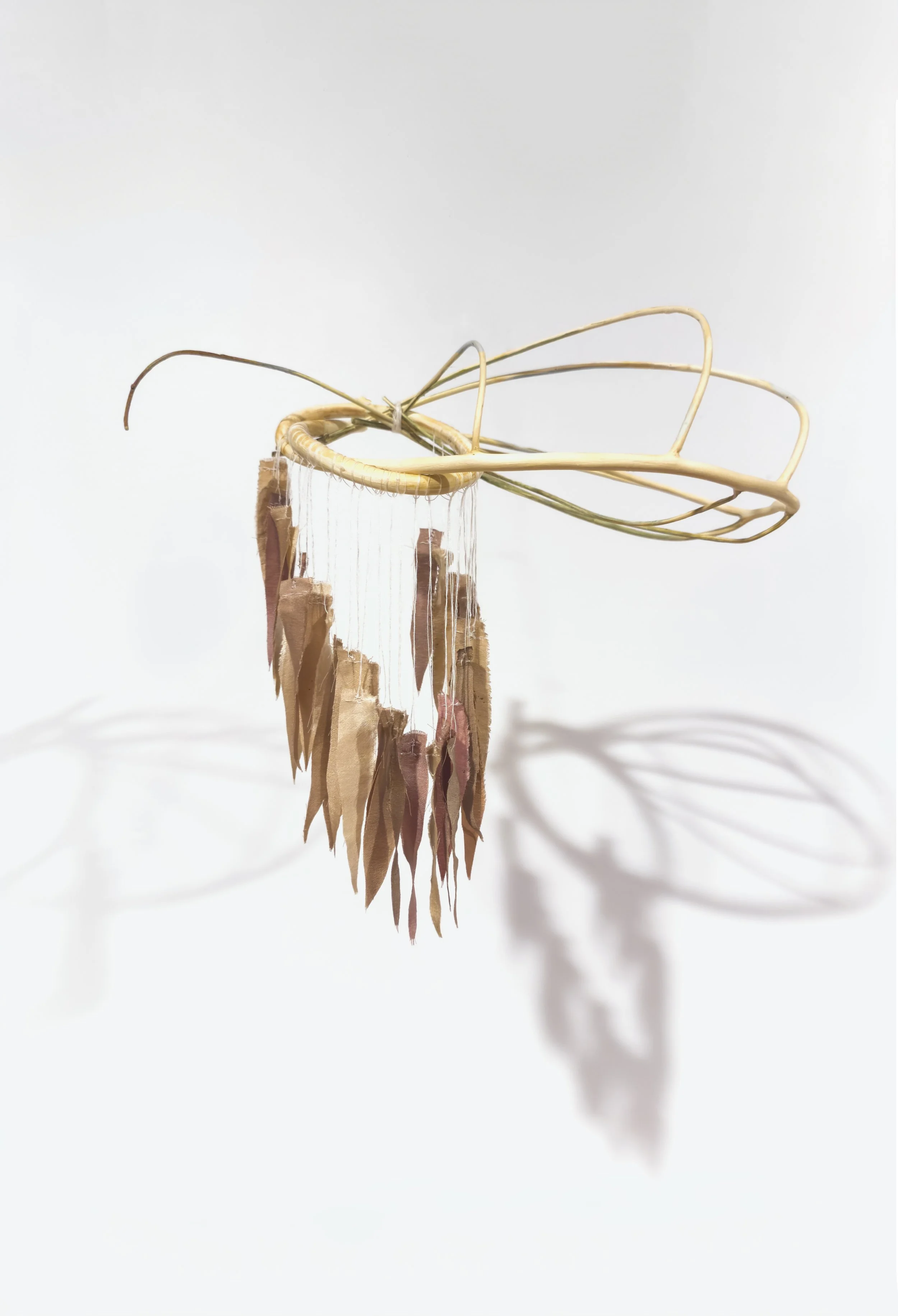
Clewe 2026 A portable compass-form made from hand-bent garden elm suckers and lichen-dyed silk. The silk is cut into compass points oriented toward the earth, while thread lengths map lunar illumination across the month. The dyes were fermented as a daily sequence over summer 2024 to 2025 using chamber lye and grey lichens gathered from windfall while clearing woodpiles for fire protection. Made during the 2025 to 2026 fire season, Clewe was conceived as an object to be held and carried, a route back to sensory awareness of place and time under evacuation conditions.
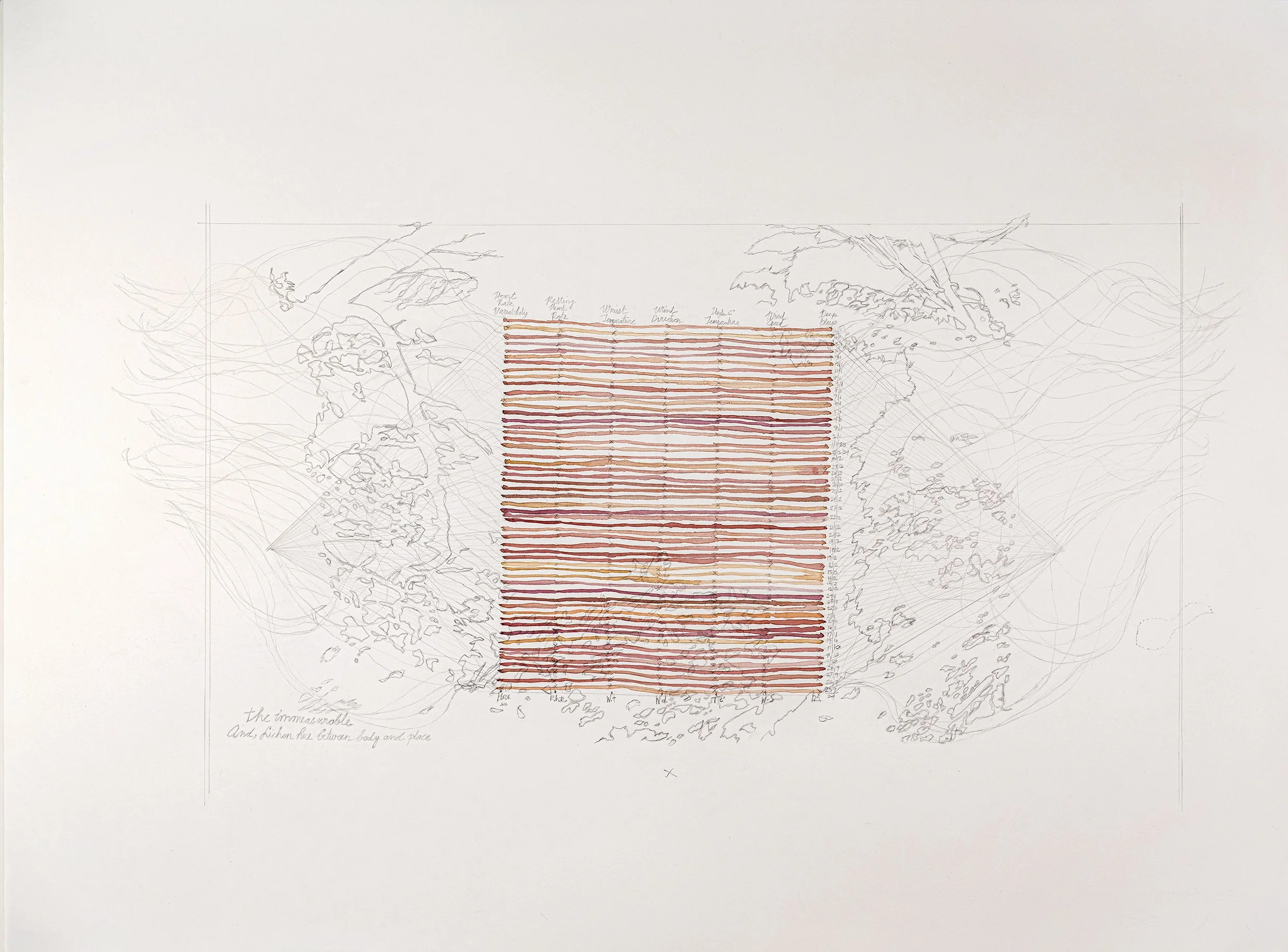
Waters’ Colour Calendar: An Atlas of Measured Unknowing 2026 This work draws on fifty four days of readings translated through lichen dye made by long fermentation in chamber lye. Hue becomes a bioindicator, or litmus, of time in this place. Outlines of the peppermint gums where wind-fallen lichens were gathered shift between foliage and landform. A central chart sits pinned, a map of tonal text, guesses, and everything in between. Measured lines extend through the gum bodies, while bilateral drawing moves beyond the chart as tracks, paths, or waves. The work holds note-taking, measurement, incomprehension, and hope, making partially visible the strait between body and place.

Everyday Holobionts: Strata 2025 Daily measurements of temperature, wind, sleep, and autonomic markers are translated into horizontal strata painted with lichen ink. Each line is a day, shaped by shared chemistry between lichen, body, and place. Built as a compression of time rather than a sequence, the work forms a cross section of internal and external weather. Days accumulate as depth. Fermentation, bodily variation, and changing conditions press unevenly into the surface, making a temporal geology of co-regulated pattern.
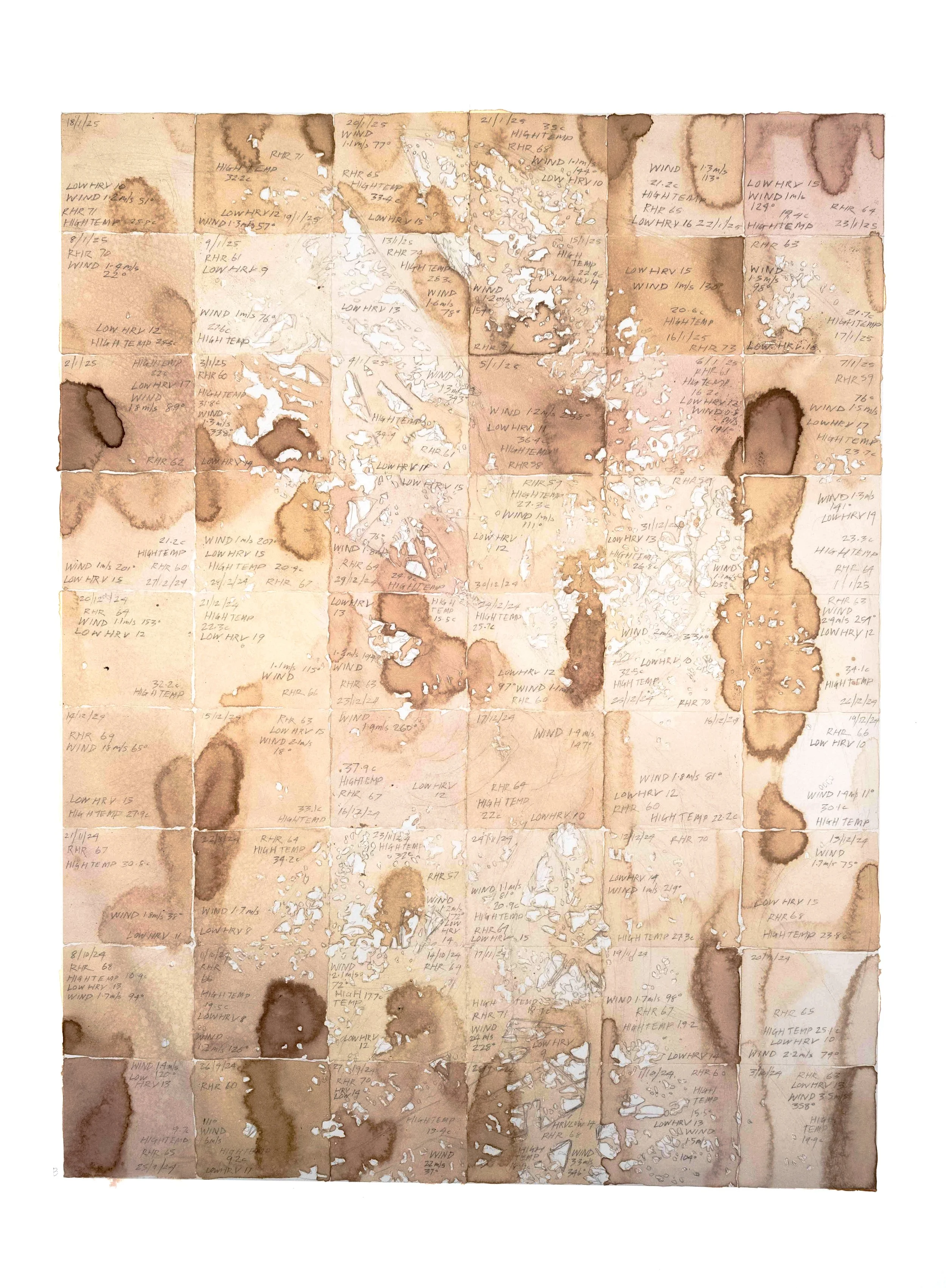
Everyday Holobionts: Co Terrain 2025 A fifty four day record of body and place. Each square holds wind, temperature, heart rate variability, and resting pulse, written into lichen ink made from ethically gathered windfall species. Here the grid becomes a mapped co-terrain, where body and environment meet through daily variation. Ink and data sit together without resolving into sameness, holding the subtle co-temporality through which place and body act on one another.