Convergences
2021–2024
Convergences is a moving image work made from an interview at site, layered with landscapes moving through other landscapes. Moving with sticks through the site, my figure is layered with canopy, rock, path, leaf litter, sky and shadow. The body is filled and emptied by place while also trying to find a way through it. The work follows how land, illness, memory, weather and inherited histories move through one another, and how place can become a teacher for movement, attention and re-pair.
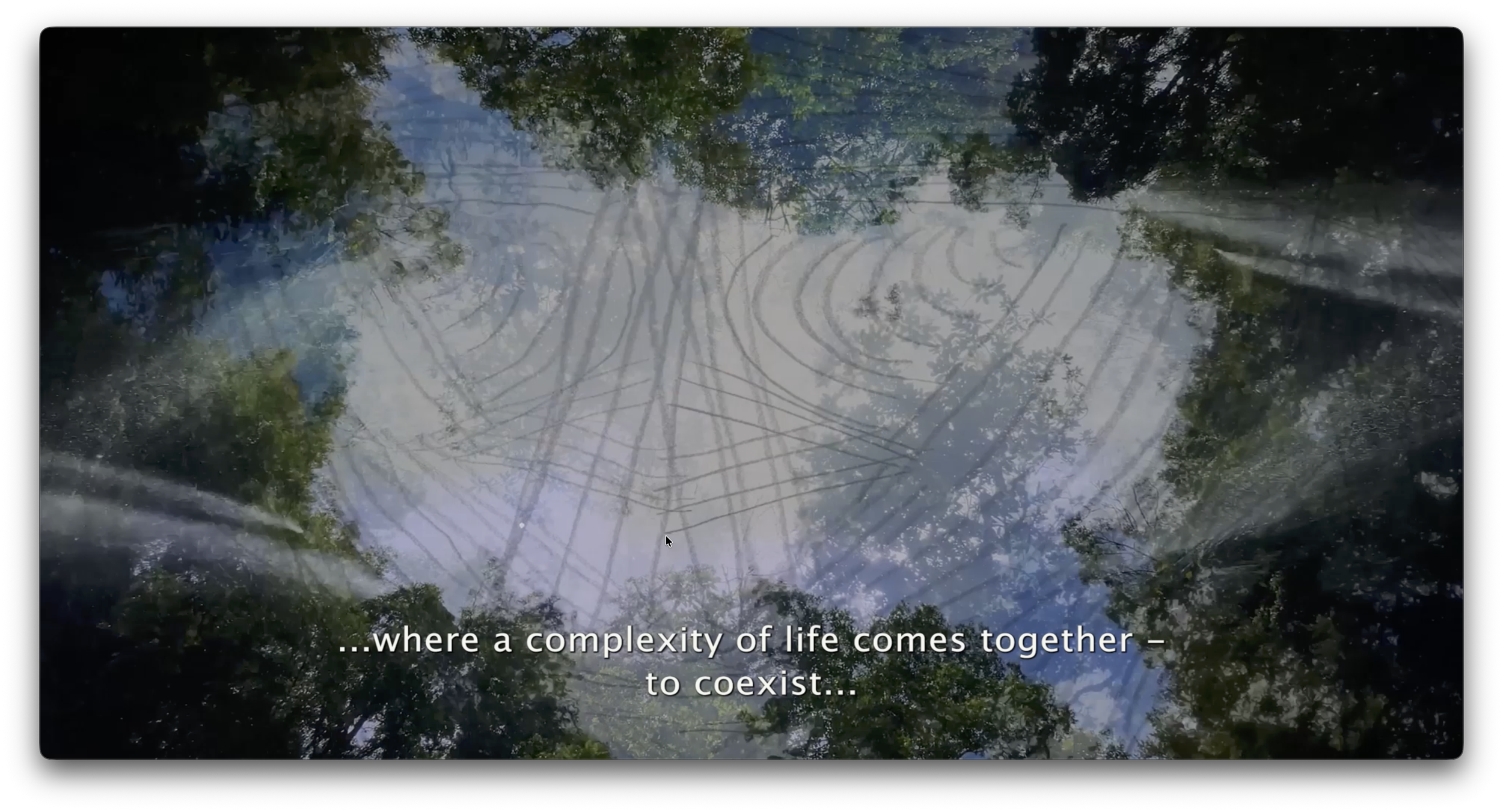
Convergences developed through several iterations. The first version was made from an interview at site, with my voice and layered environmental sound. I later returned to the footage, heavily layering landscape, pattern and my moving figure in response to the interview. This layered version showed at Cooroy and Caloundra. For a later Lismore iteration, the soundtrack was rebuilt with environmental field recordings and an aeolian harp made by Ross Annels, then some of the cut interview text returned to the work as subtitles.
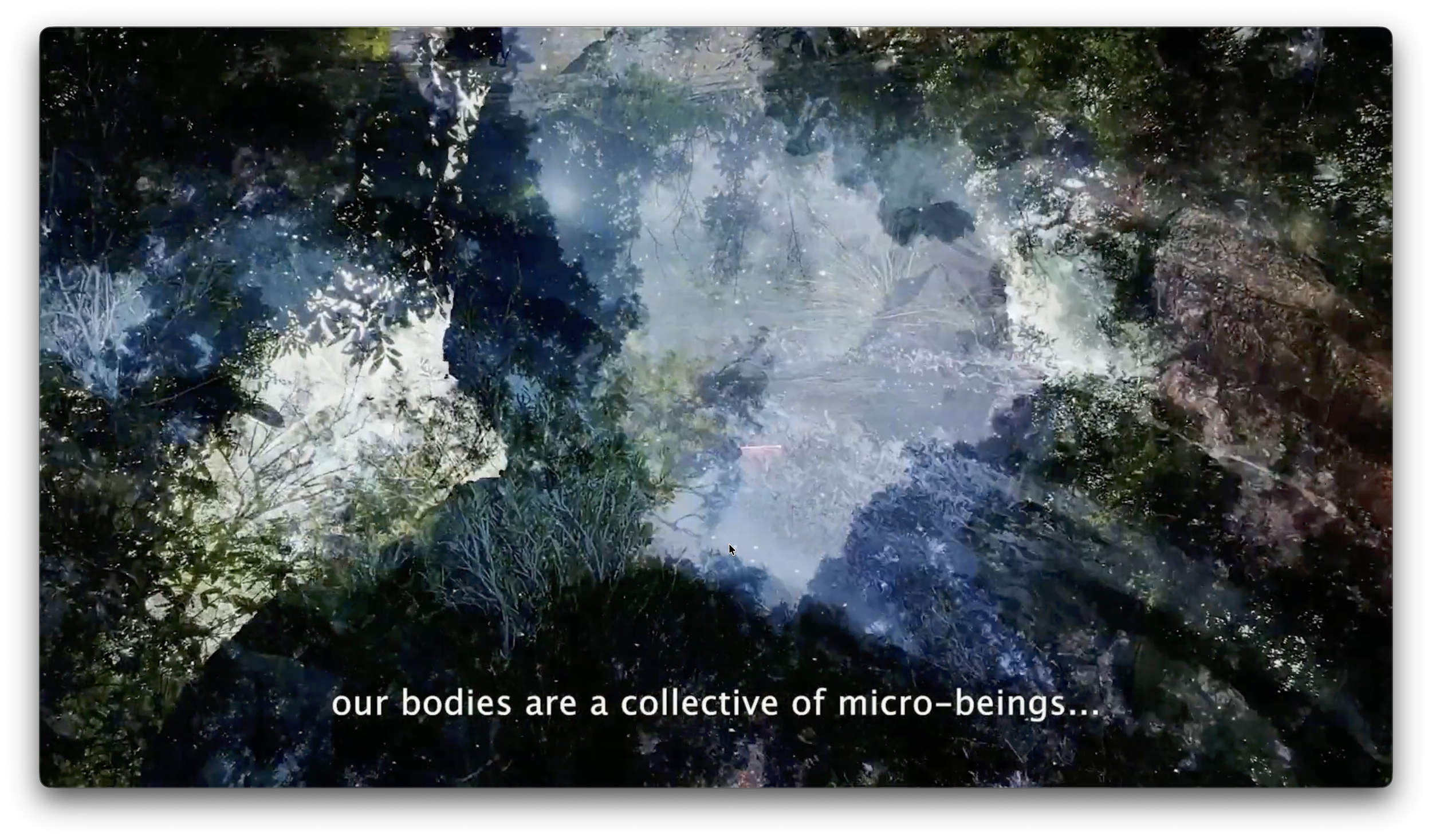
The work grows from meeting place as alive, changing, and full of other beings. Soil, rock, water, plants, weather, bacteria, roots, bones, and bodies move together. A place is a shifting set of negotiations. I move within it as another temporary arrangement.
I am drawn to edges and crossings, to sites where systems overlap. Creek lines, ridges, eroded rock faces, changes in soil, shifts in wind. These are places where different forces and times meet. They can feel protective or unstable. They show how life holds together through adaptation.
With illness and periods of limited mobility, I learned to move by learning how places move. My sensory system takes in more information than it easily filters. By staying with one location over time, I learn its regularities and disruptions. Where water bends grass. Where wind shapes bark. Where soil holds or releases. This becomes a way of knowing when to move, how to rest, how to stay.
The film follows this learning. It traces desire lines, informal paths shaped by repeated movement rather than imposed design. Animals make them. People make them. Weather makes them. These are not shortcuts. They are records of how movement is negotiated within a place, shaped through repeated contact between bodies, terrain, and weather.
Convergences also holds shared histories carried by bodies and landscapes. I grew up within family histories entangled with land use, farming, plant cultivation, development, and political power. I witnessed land being cleared, misused, and devalued. I also witnessed how certain bodies and lives are treated in similar ways. Disregard moves across territory and flesh.
The film considers how land continues to mend. How roots alter their shape around stone. How water persists. How structure and softness coexist. These processes sit alongside my own slow re-pair.
Convergences is a listening practice.
It sits between thinking and sensing.
Between movement and stillness.
Between the human figure and the place moving through it.
Attention becomes a way to stay with what is changing.
“We are all part of this.”


Text from the film
The text below comes from the interview used in Convergences. It has been edited from the film subtitles while keeping the spoken structure of the original conversation:
It’s a relationship.
We’re all part of this. Our bodies are a collective of micro-beings.
When I visit a place, I like to meet it. I see places as beings in themselves, and I’m just a conglomerate of beings myself. So it’s like meeting an older, more complex, cleverer being, and I try to learn from it.
I like visiting places where there are intersections or convergences of things, where a complexity of life comes together to coexist. There will often be an intricate weave or knitting holding everything together. It can feel really powerful, or even untethered. But it can appear anywhere, like where soil or weather patterns change.
I like looking closely at those areas to try to understand how to live in our complex world. This land can teach us a lot about ourselves, about working together and learning from our non-anthro community.
I learn a lot just observing space, place, time, how things move together, hold together, and how they separate or change.
Somewhere like this, you’ve got the roots and the rocks. They’ve all had to change their shape. Everything’s had to adapt, to coexist together, and you get all these wonderful patterns and forms, both hard and soft.
There’s really long-time form, like rock, and short-term form, like roots, but they’re similar. They’re showing you how this place moves.
With my health and limited mobility, I had to learn how to read how things were moving around me so I could move with the environment, and feel connected and aware.
So I look for the flow of places, the way of things, the way the land is moving, so I can feel safe, and feel like I know how to be with, and in, that place. Because it’s all alive and moving.
You can see here where the water’s been. Everything’s bent. The wind does that too. All the different shapes. Wood does it. Our bones do it. There are these patterns we carry around inside us.
And we’re a bunch of microorganisms working together.
So I think sometimes I try to readjust myself by going and finding places like this, so I can feel a bit like I’m in the flow of things as well.
Everything’s moving. We’re all part of this. I don’t think we know very much. We forget that we are just one part of so much more.
So I like to listen, and get to know, and find the way of a place.
Animals make paths through places. Humans make them too, sometimes called desire lines. A designer will make a path around a building, but people will cut through and make a track of their own. It will be the way that feels easiest to move through that place.
I think subconsciously we are always trying to find the way of a place.
We can be led by a place, and find the flow of the land. The wind and the water are always moving through us, shaping everything, shaping our bones, our bodies, our ways.
My illness immobilises my body. I have to learn to move again, every time. My sensory system takes in much more information than I can process.
I found that if I got to know my environment, the way of it, the way it moves, I could see when things were moving outside the pattern of the place. Where the edges are, and where change is likely to occur.
It allows me to move with place.
We get so caught in our thoughts. I was really good at thinking my way through things until my body stopped moving, and I realised I was taking in so much sensory information but ignoring most of it.
I had to stop and listen to what this organism, my body, was perceiving.
Research shows we take in very little of the information we are presented with. It’s just too much. Our brains match patterns so we can multitask and move without thinking.
Mine doesn’t. It wants to examine every bit of information, and will stop me moving to do this.
I realised I needed to get to know places to avoid overwhelming myself. So I try to learn from the ground.
I often spend a lot of time in one place, to understand its complexities, what causes disruptions and change, and how places hold together. These convergences of complex phenomena.
I notice where wind becomes a ridge, where water makes a path, where soil changes, where the air moves differently, and remind myself what it means to be human.
I’m not separate.
This place is a campsite in an old national park, bordering commercial plantation forest, after fire and flood.
My history is complex, like a lot of us, so I won’t go into it deeply.
I grew up in a small town in Queensland where my family had lived for quite a few generations. We had a plant nursery. I spent a lot of time with plants. They became like family.
Plants weren’t very valued. The land wasn’t very valued.
My family has two sides: farmers and plant growers, and politicians and developers.
And so I saw a lot of land being misused, and a lot of things not being valued. I saw the way we treat parts of ourselves. We don’t treat certain parts of ourselves, or our culture, with respect, in the same way we don’t treat land with respect.
So trying to find peace with all the violence I’ve seen, and have in my body, from the history of this place, is something I’m always working with.
I try to see how the land mends, so I can see how I can mend.
The land was often referred to as scrub. They’d say, clear it, just a bit of scrub. And it’s also used as a derogatory term for women, scrubber. There’s a lot of stuff that overlaps with our lack of respect for place.
A lot of it comes from damaged and uprooted cultures, colonial cultures, which have denied relationships with place to absolve conscience.
Relationships with place were denied and devalued so land could be stolen.
We all still live with the consequences of this, and the trauma of silencing a history of violence.
To deny humanity’s interdependence with our environment is hurting.
It’s dangerous.