Everyday Holobionts
Everyday Holobionts is an ongoing durational practice with wind-fallen lichens, chamber lye, body chemistry and daily weather on Wadawurrung Country at Mount Egerton. The work maps co-terrain and co-temporality across paper and silk, holding the shared space where body, lichen, bacteria, season and place move through one another.
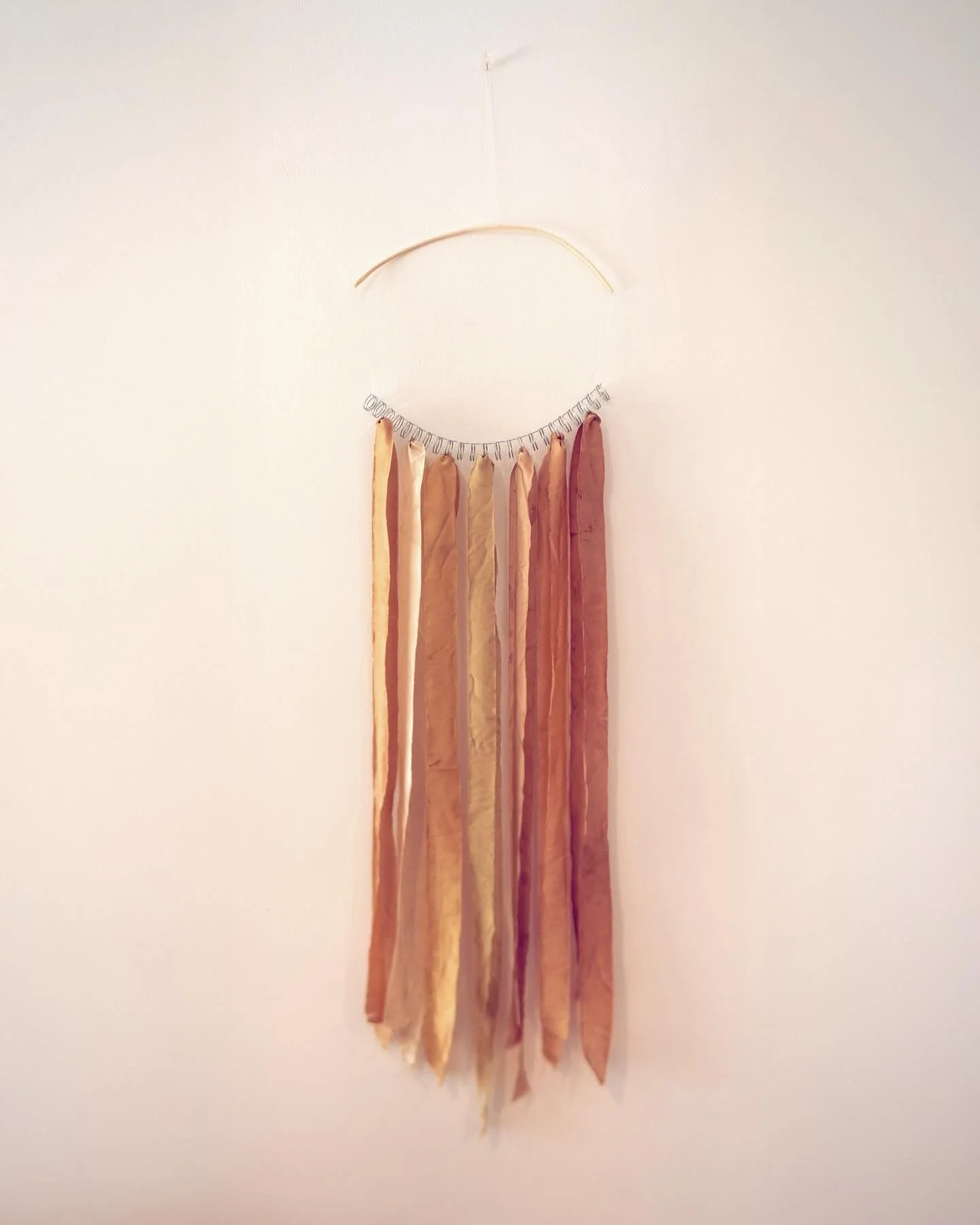
A Litmus of Time 2024–2025 Lichen dye on silk and paper, daily urine-based ferment, weather and body data The first calendar work made after arriving at Mount Egerton. The silk ribbons hold the earliest colour trials from spring 2024, dyed before a studio existed, using only what was available at hand. The later paper calendars extend this method into daily grids and strata, mapping how body and place respond to time and weather together.

Everyday Holobionts: Co Terrain A 54 day record of body and place. Each square holds wind, temperature, heart rate variability and resting pulse, written into lichen ink made from ethically gathered windfall species. The ink and data reveal a shared co-terrain, and the subtle co-temporality through which body and environment meet each day.
Field Notes: Everyday Holobionts
Mount Egerton, Wadawurrung Country, 2024–ongoing
This body of work commenced in my first few months of living on Wadawurrung Country at Mount Egerton. The lichens surrounding my home are prolific. They coat trees, rocks, ground and structures. They fall when gums moult bark, or when winds bring down branches and sticks.
Lichens do not have filters to choose what they receive, and neither do I. Together we form a living record of what has moved through us, layered by the changing conditions of a shared ecosystem.
After years of working with microbial and material intelligence, and with mistletoe as a guide into symbiotic life, lichens widened what I thought I understood about species. They are not singular beings but adaptive collectives, agreements made and remade between fungus, algae, bacteria, weather and substrate. Something like endosymbiosis in slow motion. As bioindicators, they hold what has moved through the places where they live.
All of the lichen I work with is windfall. I do not remove lichen from living substrates. Lichens grow slowly, often only a millimetre a year. Here, fallen branches and sticks are gathered for fire prevention. My unwillingness to add lichen to our fireplace means much of it remains. It is how we came to work together. I run a small experiment in regeneration, though I will not know for many years whether any of it works.
Chamber lye is a traditional alkaline dye base made from urine, used historically in lichen dyeing and other textile processes. Older methods relied on stale urine to create the conditions needed for colour to develop. I am using that old process, but listening to the colour for something else: what it might tell of the space between body and place, as document, record, or augury.
It also becomes a daily indicator of my internal weather: mineral presences, fatigue, hydration, medication, heat and stress. Each hue holds a long exposure of a day’s chemistry between body and place. Colour, viscosity and pooling write peculiar vocabularies between organisms.
The work moves across paper and fabric, through ink and dye, in sheets, strips, calendars and strata. The distinction between drawing and dyeing is porous.
Moving between bodies of weather, pattern and time, I began to recognise co-temporality. Beside it, co-terrain emerged: a place where time, weather and being gather, each keeping their own time.
Broken River language
These works arise from personal and cultural disruption, and from an attempt to re-pair ways of being with a place I have no familial understanding of, after leaving one I had lived in for generations. They are eddies in my broken stream. Working alongside lichens has become one way of staying with the world, its unfiltered complexity, intimacy and brutality.
Everyday holobiont life is breathing, digesting, sweating, fermenting, weathering, resting, failing and adapting. It is mutual dependence without guarantee. Lichen and body chemistry alter each other here. Neither controls the outcome. Both carry what has passed through them. This is one way of keeping company with this place, and with the many lives that move through me and around me each day.

Everyday Holobionts: Strata. 2025 Daily measurements of temperature, wind, sleep and autonomic markers are translated into horizontal strata painted with lichen ink. Each line is a day shaped by the shared chemistry of lichen, body and place. The work traces subtle exchanges between internal and external weather, forming a cross section of co-regulated patterns.
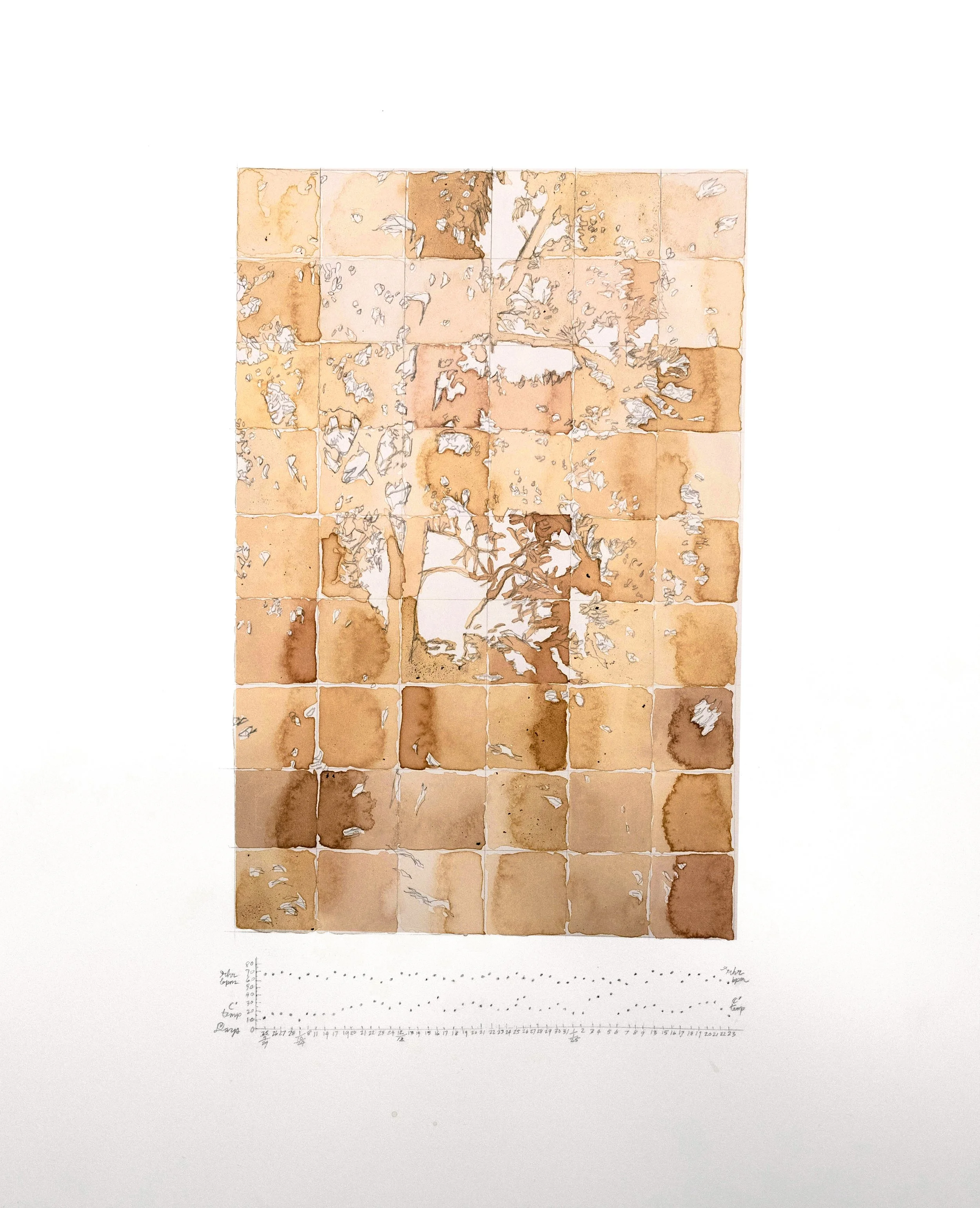
Waters’ Colour 2025 A 54 day record of body and place. Each square holds wind, temperature, heart rate variability and resting pulse, written into lichen ink made from ethically gathered windfall species. The ink forms its own terrain, merging with the mapped data to show a shared co terrain between body and environment.