Photography/moving image/sound
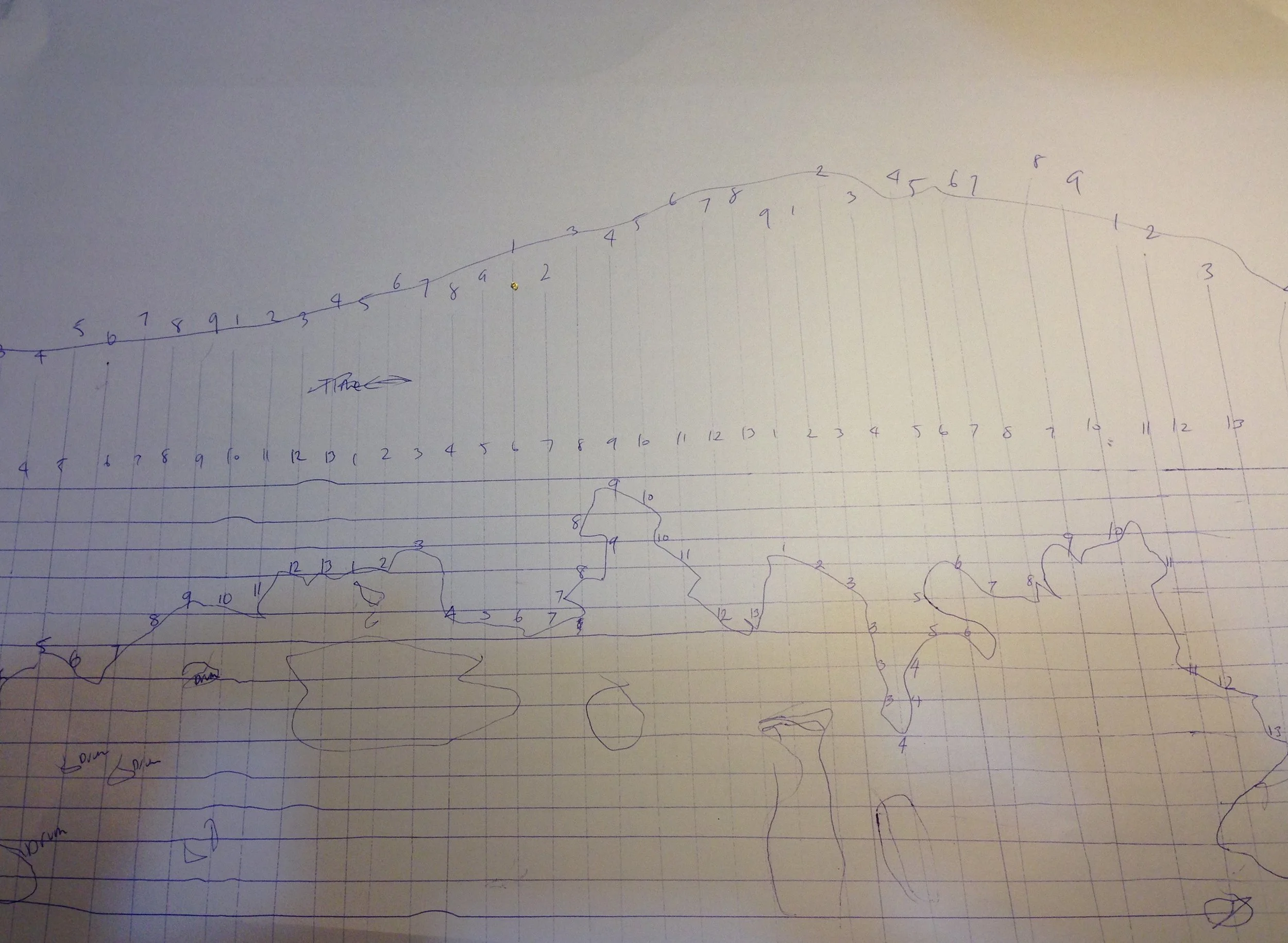
Much of my image practice begins with the weather. Smoke, mist and refracted light can make weather briefly visible as it moves through a place.
I use campfire smoke, camp lights, coloured lights and ultraviolet light. I feel like I have some primordial need to use smoke to scry. I watch it shape itself and consider how things are moving.
Different light
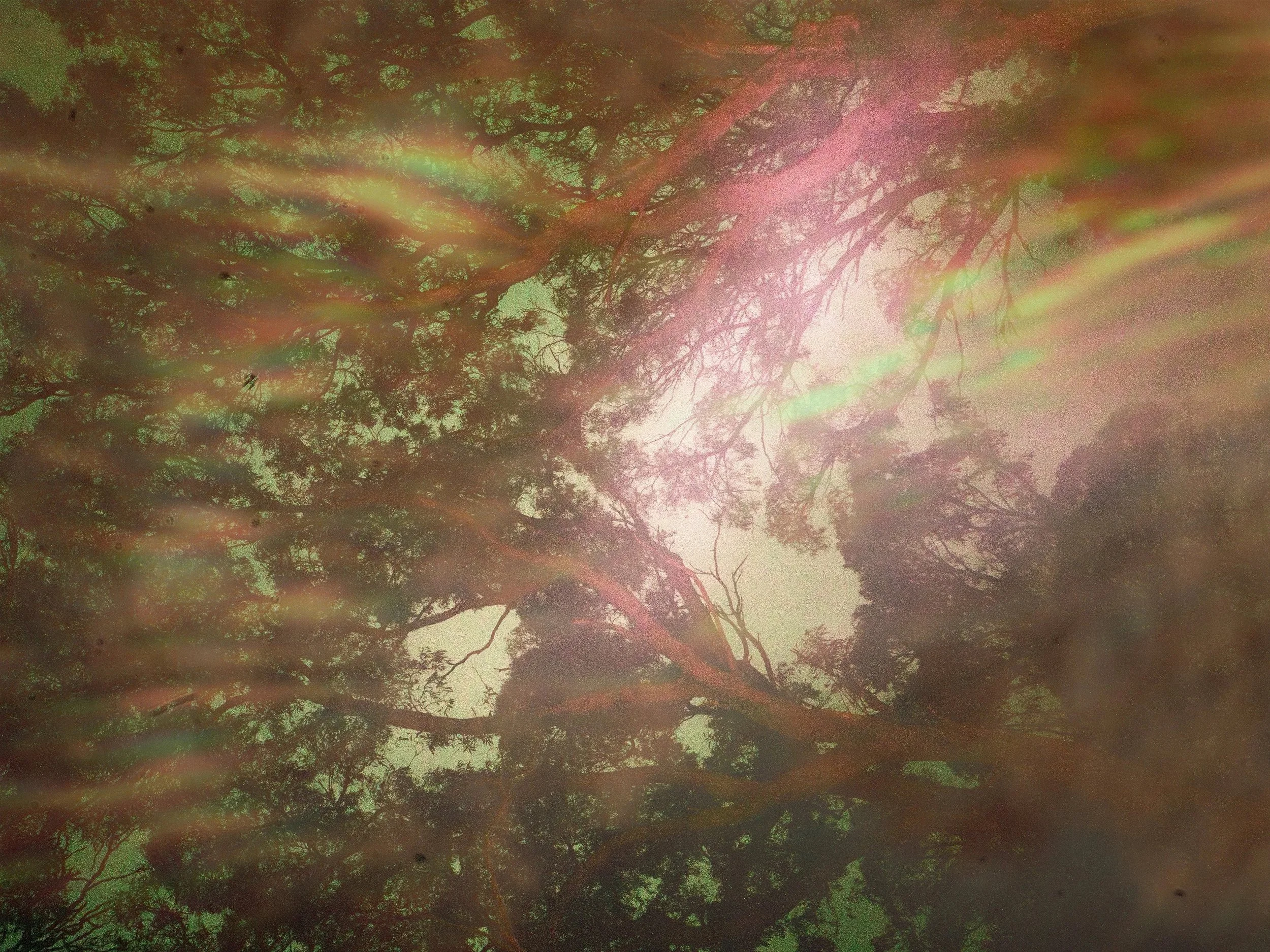
I work with infrared cameras at different wavelengths, full-spectrum cameras, including full-spectrum pinhole work, and ultraviolet filters. I also use a small collection of Micro Four Thirds cameras, and an old beat-up film camera, plus moving-image cameras ranging from Super 8 film cameras to 360s to GoPros.
Each camera has its own personality. They see the world differently. I often think about how we have been conditioned to see the world through the lens - and the technologies that were successful in developing those images.
Colour, I consider a lot- as something that is more a product of safety and technology than as a direct product of what is actually visible. We are influenced by what technology has taught us to see.
I also use plant chemistry with photographic paper to create imprints of interactions and collisions between botanicals. This helps me understand permeability and porousness.
Overlays
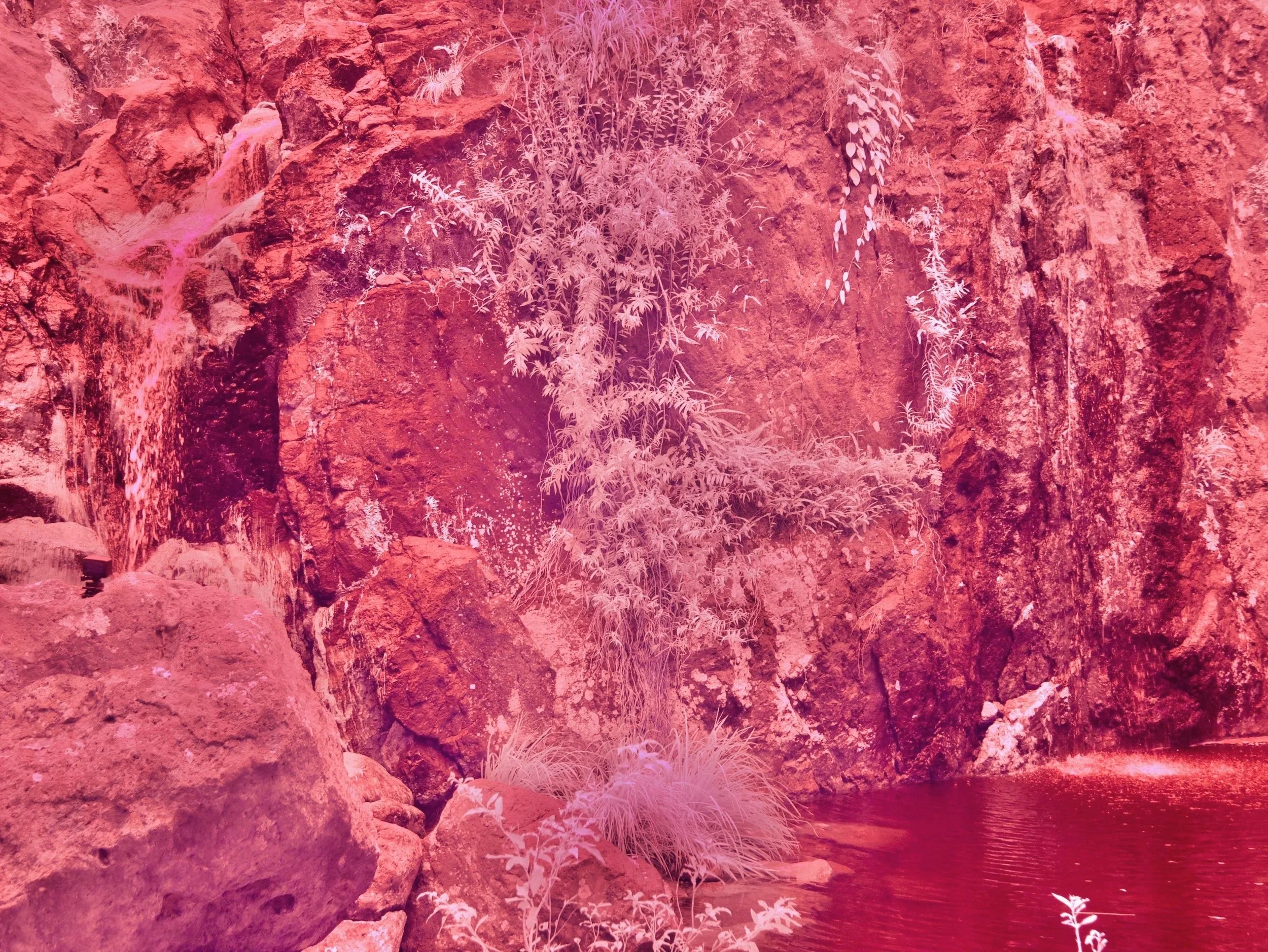
Overlaying is my most-used methods. I layer photographs made with different cameras, wavelengths, moments and materials. Multiple images can hold several encounters with a place across milli-moments. Light and weather change continuously. Human time is one scale; there are many other beings’ timescales that cameras can sometimes help me perceive.
I sometimes think of these works as a sheaf of planes: a loose gathering of image surfaces. A photograph, drawing or plant ink can occupy a different plane, each carrying its own time, scale and material history.
I work with overlays as a kind of geology of material. A photograph may meet a bilateral drawing, a scan, a stain, a fragment from my library of ephemera or another photograph.
Overlaying is most visible in the photographic work, but it also runs through my drawing, textile, moving-image and installation work. It encourages a practice of sortition, allowing different materials, scales and times to conjure alternative versions of place and time. And I think it’s related to my experience of sensory overwhelm, where everything feels like it’s happening at once.
Moving image and time
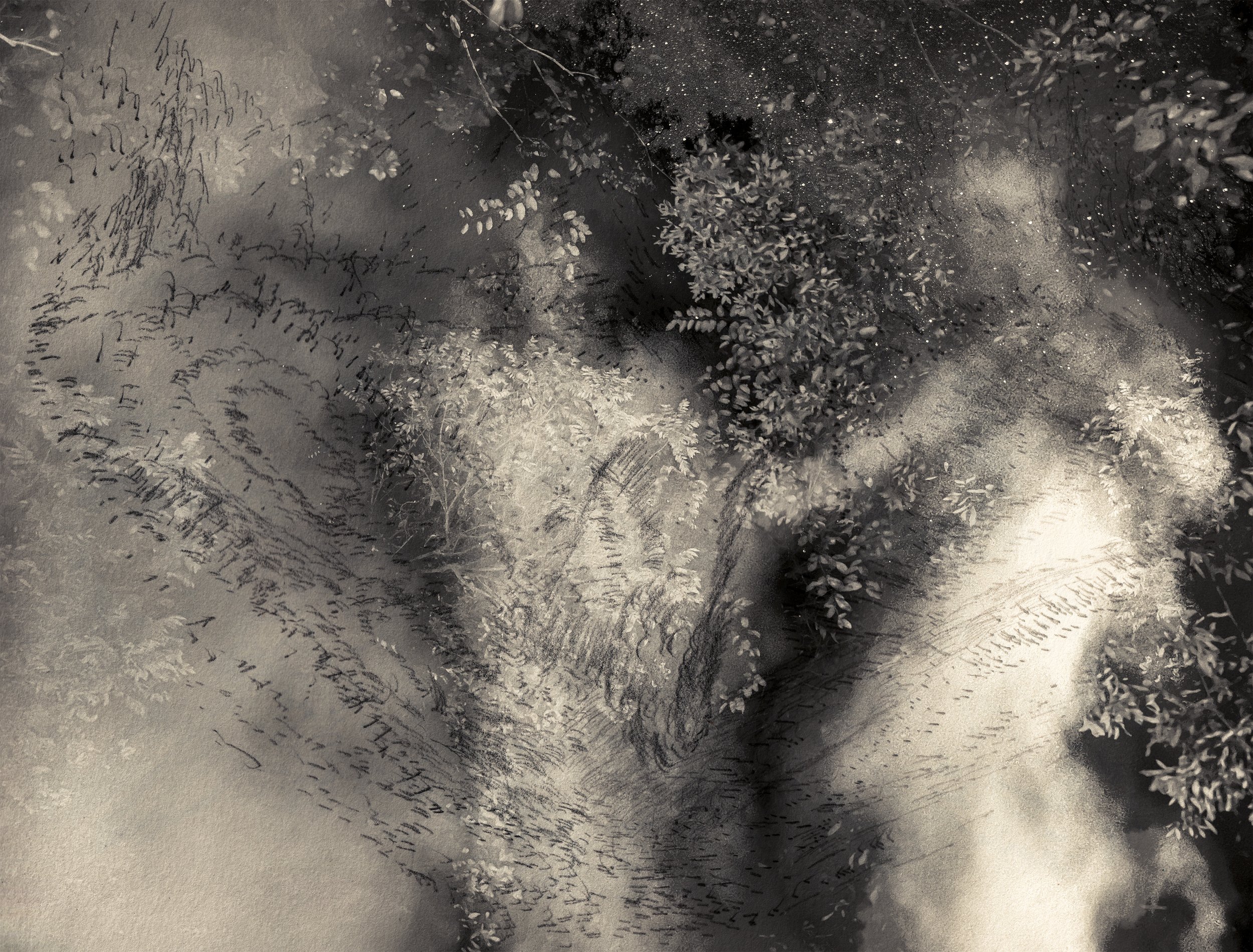
Moving image gives weather, bodies and materials time to shift.
In the film Convergences, I walk with my sticks through the landscape and the landscape moves through me. Overlays of places meet and change within my body’s outline.
Astro time-lapse lets night, cloud, firelight and galactic movement appear together in one image. In the installation Everything is Speaking, time-lapses move across fabric, walls and ceilings, alongside drawing, light, sound and mistletoe forms.
Film is a way to experience different times all at once.
Wind, vibration and altered speed
I compose soundscapes and scores for installations, working with environmental recordings, voice, Aeolian harps, analogue circuits, speakers, headphones and vibration.
I use contact microphones, hydrophones, directional and 3D microphones, and a 32-bit float recorder. I use a spectrograph to look for frequencies and events beyond my hearing. Long-duration recorders such as AudioMoths can be left in a place to gather what passes through over time.
I slow ultrasonic recordings down and speed infrasonic recordings up, so that sounds outside ordinary hearing can be heard at another scale.
In The breeze at dawn has secrets to tell you …, Ross Annels made a steam-bent Bunya and cast silicone stool, along with prototype Aeolian harps made from Bunya, bamboo, red cedar, harp pins and nylon monofilament. I composed and composited a thirty-minute soundscape from recordings Ross and I gathered on Bunya Country using the harps and digital recorders.
The soundscape was an attempt to give an example of the sounds a Bunya pine might hear over time. It was reproduced through transducers in the stool and headphones.
The Analogue Environmental Sound Synthesiser, made with Ross for Floating Land, was a listening structure at the edge of Lake Cootharaba. It brought environmental signals and bodily rhythms into an analogue circuit, a synthesis of our vascular systems and the Noosa Everglades that could be heard through the shell-shaped earpiece.
In All a long longing and Everything is Speaking, sound also moves through vibration, fabric, carved forms and bodies. I sang 80s breakup songs and peak capitalist hits, and reversed them as a means of undoing harm. They became layers within atmospheric recordings.
Sound and receiving
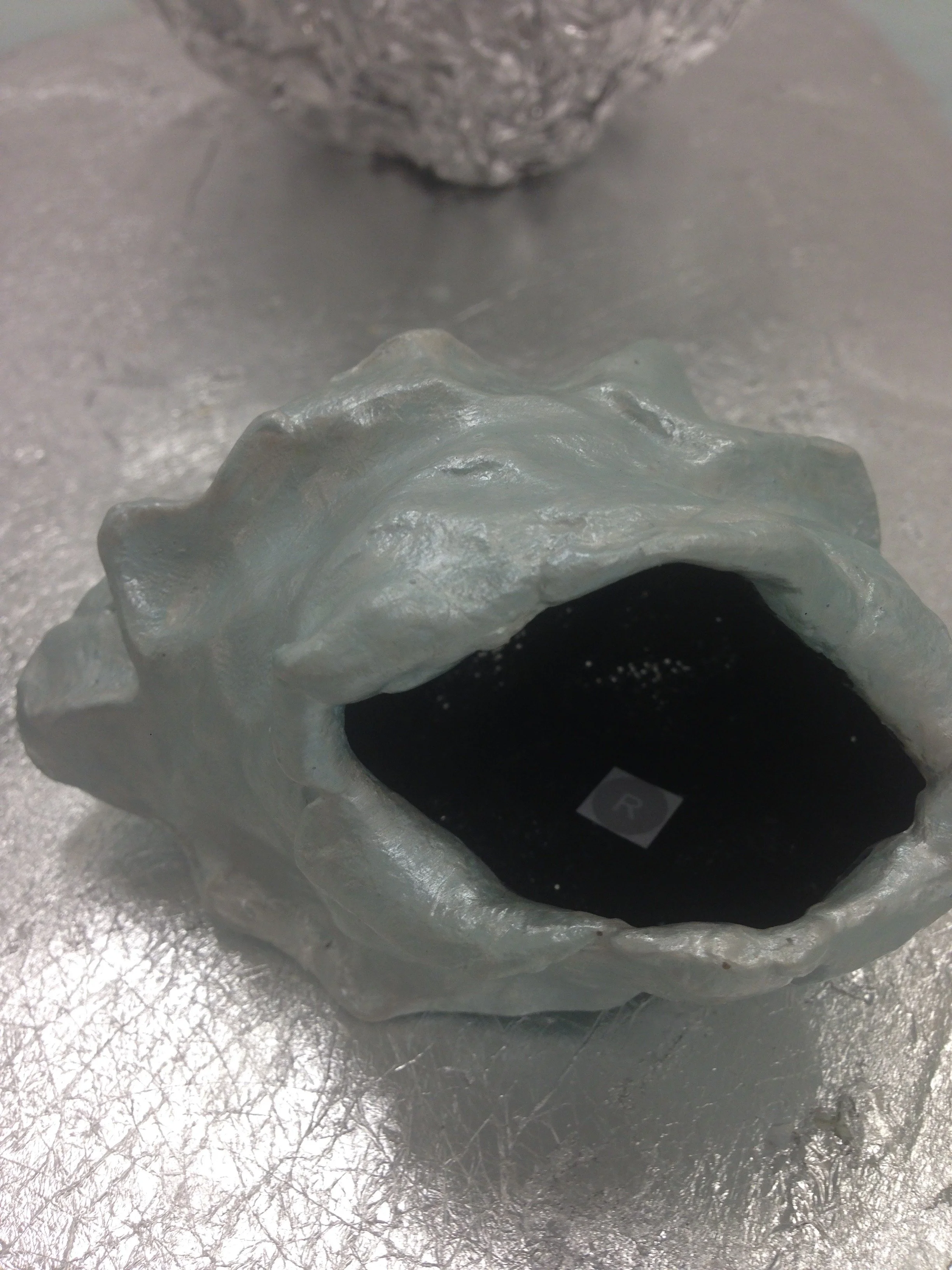
Bilateral Clay Recordings began with air-drying clay. Some of the clay forms become recorders of intent, affect or pressure. Some are resonance chambers, made to be held to the ear. The work grew from questions of what sound objects held, what sounds orbiting planets made, and how their shapes informed their vibrations and acoustics. I was also intent on recording the sound between space, otherwise known as silence (but nothing is silent). I was obsessed with the study of archaeoacoustics and the possibility that geological forms may be able to recreate ancient human ceremonial sounds.
The Book of Receivings, made with Judith Hamann, began from questions of sending and receiving across distance without direct language, instead using a seismic type of proprioceptive technique relayed through our environment.
Forest Telephonists, made with Tara Gilbee, converted recorded sound and visual notes into a slow-motion two-screen conversation between distant places.
These projects inform parts of my current sound practice. They are part of why listening, for me, is not only about the ear or an audible signal.
Related projects